
Vedic Astrology Calc
Vedic astrology (Jyotish) uses the sidereal zodiac, aligned with the fixed stars, so planets usually sit in a different sign from Western charts. Enter your birth details to see your Lagna (ascendant), the rashi, nakshatra and pada of every graha and a South Indian chart. The positions are computed in your browser with standard astronomical approximations.
- Free to use
- No sign-up
- Runs in your browser
Vedic birth chart calculator
Vedic Chart Worksheet Pack
Printable blank South Indian and North Indian chart templates, a nakshatra reference table with lords and spans, a rashi and graha reference card and a birth chart record sheet.
- Blank chart templates (PDF)
- Nakshatra table (PDF/XLSX)
- Rashi card (PDF)
- Chart record (PDF/DOCX/XLSX)
Formats: PDF, XLSX, DOCX. Instant download after payment (link valid 72 hours, up to 5 downloads). AI-assisted: the templates were drafted with AI help and reviewed and laid out before publishing.
$3.00 USD, one-time 4 files · about $0.75 each
- Instant download
- 7-day refund
- Secure checkout by Stripe
7-day money-back guarantee. Full refund within 7 days of purchase, even after you download.
Free sample: Birth Chart Record (PDF, 95 KB)
Full refund within 7 days — see the refund policy and license.
Free printables
Single sheets you can print right now, no sign-up. The full pack adds every sheet in one download plus the editable files.
 Printable Vedic Chart Record
Sidereal vs tropical zodiac
Western (tropical) astrology fixes 0° Aries at the March equinox. Vedic astrology uses the sidereal zodiac, fixed against the stars. Because the equinox slowly drifts backwards through the constellations (precession), the two zodiacs are now about 24° apart. That difference is the ayanamsa: sidereal longitude = tropical longitude − ayanamsa. Lahiri (Chitrapaksha), the ayanamsa adopted officially in India, is the default; Raman and Krishnamurti (KP) are popular alternatives that differ by up to about 1.5°.
What the calculator shows
| Item | Meaning |
|---|---|
| Lagna | The rising sign on the eastern horizon at birth — the first house |
| Rashi | The sidereal sign of each graha (planet) |
| Nakshatra | One of 27 lunar mansions of 13°20′ each |
| Pada | A quarter of a nakshatra (3°20′) |
| House | Whole-sign house counted from the Lagna |
| (R) | Retrograde — the planet appears to move backwards |
| Rahu and Ketu | The Moon’s mean north and south nodes, always opposite each other |
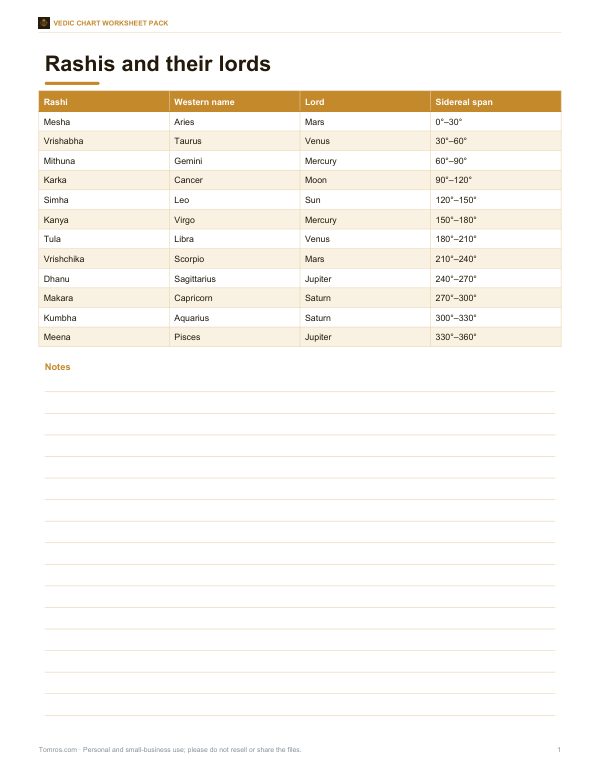
The twelve rashis
| Rashi | Western name | Lord |
|---|---|---|
| Mesha | Aries | Mars |
| Vrishabha | Taurus | Venus |
| Mithuna | Gemini | Mercury |
| Karka | Cancer | Moon |
| Simha | Leo | Sun |
| Kanya | Virgo | Mercury |
| Tula | Libra | Venus |
| Vrishchika | Scorpio | Mars |
| Dhanu | Sagittarius | Jupiter |
| Makara | Capricorn | Saturn |
| Kumbha | Aquarius | Saturn |
| Meena | Pisces | Jupiter |
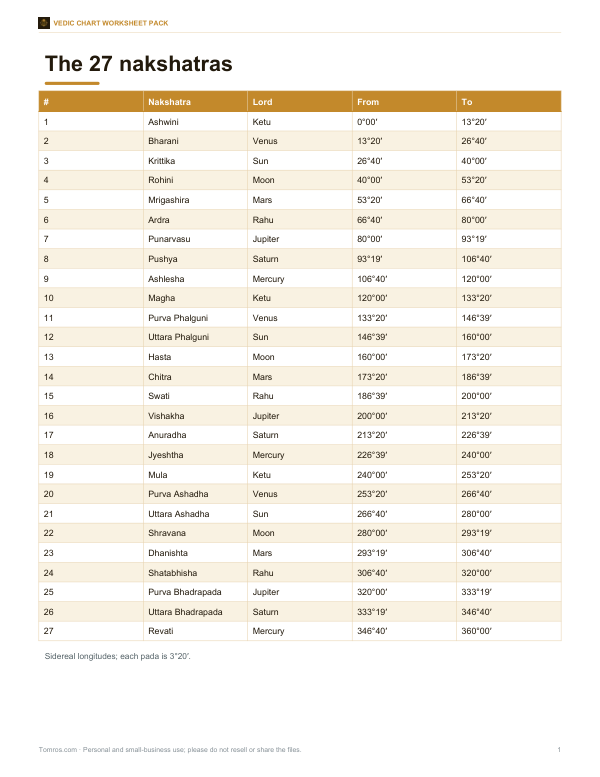
The 27 nakshatras
| # | Nakshatra | Lord | Sidereal span |
|---|---|---|---|
| 1 | Ashwini | Ketu | 0°00′ – 13°20′ |
| 2 | Bharani | Venus | 13°20′ – 26°40′ |
| 3 | Krittika | Sun | 26°40′ – 40°00′ |
| 4 | Rohini | Moon | 40°00′ – 53°20′ |
| 5 | Mrigashira | Mars | 53°20′ – 66°40′ |
| 6 | Ardra | Rahu | 66°40′ – 80°00′ |
| 7 | Punarvasu | Jupiter | 80°00′ – 93°19′ |
| 8 | Pushya | Saturn | 93°19′ – 106°40′ |
| 9 | Ashlesha | Mercury | 106°40′ – 120°00′ |
| 10 | Magha | Ketu | 120°00′ – 133°20′ |
| 11 | Purva Phalguni | Venus | 133°20′ – 146°39′ |
| 12 | Uttara Phalguni | Sun | 146°39′ – 160°00′ |
| 13 | Hasta | Moon | 160°00′ – 173°20′ |
| 14 | Chitra | Mars | 173°20′ – 186°39′ |
| 15 | Swati | Rahu | 186°39′ – 200°00′ |
| 16 | Vishakha | Jupiter | 200°00′ – 213°20′ |
| 17 | Anuradha | Saturn | 213°20′ – 226°39′ |
| 18 | Jyeshtha | Mercury | 226°39′ – 240°00′ |
| 19 | Mula | Ketu | 240°00′ – 253°20′ |
| 20 | Purva Ashadha | Venus | 253°20′ – 266°40′ |
| 21 | Uttara Ashadha | Sun | 266°40′ – 280°00′ |
| 22 | Shravana | Moon | 280°00′ – 293°19′ |
| 23 | Dhanishta | Mars | 293°19′ – 306°40′ |
| 24 | Shatabhisha | Rahu | 306°40′ – 320°00′ |
| 25 | Purva Bhadrapada | Jupiter | 320°00′ – 333°19′ |
| 26 | Uttara Bhadrapada | Saturn | 333°19′ – 346°40′ |
| 27 | Revati | Mercury | 346°40′ – 360°00′ |
The nakshatra lords repeat in the order Ketu, Venus, Sun, Moon, Mars, Rahu, Jupiter, Saturn, Mercury — the same sequence used for Vimshottari dasha periods.
Worked example
For a birth on 15 January 1990 at 06:30 IST (UTC+5:30) in New Delhi (28.61° N, 77.21° E) with Lahiri ayanamsa, the calculator places the Lagna in Dhanu at about 18°21′, the Sun in Makara and the Moon in Simha at about 18°00′, in Purva Phalguni nakshatra, pada 2. Rahu is in Makara and Ketu opposite in Karka. Change the birth time by 20 minutes and the Lagna degree moves by roughly 5°, which is why an accurate birth time matters.
South Indian and North Indian charts
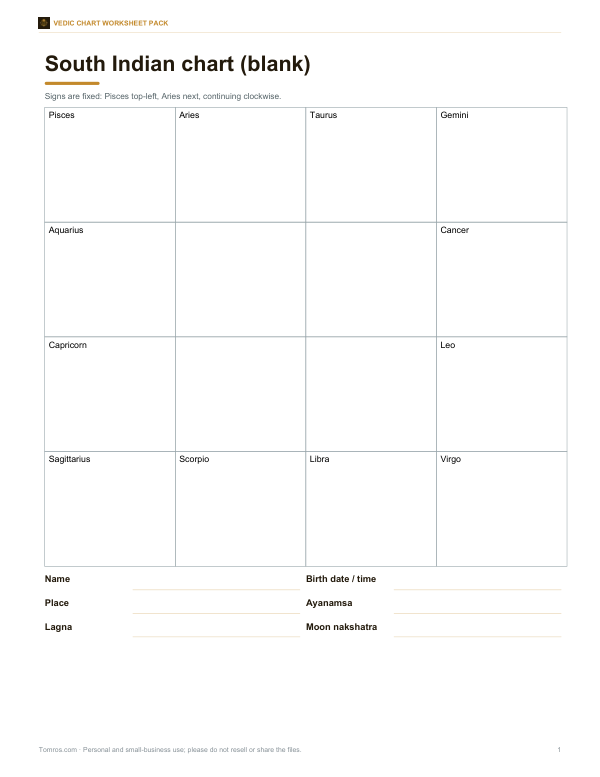
Both chart styles show the same information. In the South Indian chart, used above, the signs stay in fixed boxes — Pisces at the top-left, then Aries, Taurus and Gemini across the top, continuing clockwise — and the Lagna is marked with a diagonal line. In the North Indian chart the houses are fixed instead: the top centre diamond is always the first house, and the sign numbers change with the Lagna. The template pack includes blank versions of both.
Accuracy and limitations
- Planet positions use published approximate orbital elements and the main lunar terms; they are typically within a fraction of a degree of precise ephemerides for 1800–2050.
- The Moon moves about 13° a day, so a birth time error of an hour shifts it by about half a degree.
- Rahu and Ketu are mean nodes; some astrologers prefer the true node, which can differ by up to about 1.5°.
- Houses are whole-sign from the Lagna; other house systems give different cusps.
- Divisional charts (vargas), dashas and yogas are not calculated here.
About Jyotish
Jyotish is a traditional system with a long history in South Asia and is used by many families for naming, muhurta (timing) and life events. Its astronomical calculations are real; its interpretations are a matter of cultural tradition and personal belief rather than scientific evidence. For readings, consult a practitioner you trust.
Privacy
Birth details are processed in your browser and never uploaded.
Frequently asked questions
Why is my Vedic sign different from my Western sign?
Vedic astrology uses the sidereal zodiac, currently about 24° behind the tropical zodiac.
Which ayanamsa should I use?
Lahiri is the most widely used; follow your astrologer’s preference.
What is my Lagna?
The sign rising on the eastern horizon at your birth time and place.
What is a nakshatra pada?
One quarter of a nakshatra, 3°20′ of the zodiac.
Why does my birth time matter so much?
The Lagna changes sign roughly every two hours and moves about 1° every 4 minutes.
Are my birth details saved?
No. Everything stays in your browser.
What is the Janma nakshatra?
The nakshatra occupied by the Moon at birth, used for naming and for Vimshottari dasha.
What is the difference between rashi and Lagna?
Rashi usually means the Moon sign (Janma rashi); Lagna is the rising sign that defines the first house.
Can I enter a birth place outside India?
Yes — enter its latitude, longitude and the UTC offset in force at the time of birth, including daylight saving if it applied.